If you are a landlord, homeowner, or letting agent in London searching for a Domestic Electrical Installation Condition Report, this page covers exactly what you need: what an EICR is, what it costs, what happens during the inspection, and how to book one with a NICEIC-approved engineer. Safety Spectrum London carries out residential EICR testing across every London borough, with reports issued within 24 hours and same-day appointments available in most areas. Prices start at £79 for a studio flat. If you need testing for a business premises instead, see our Commercial EICR service, or visit our main Electrical Safety Certificate London page for an overview of all certificate types.
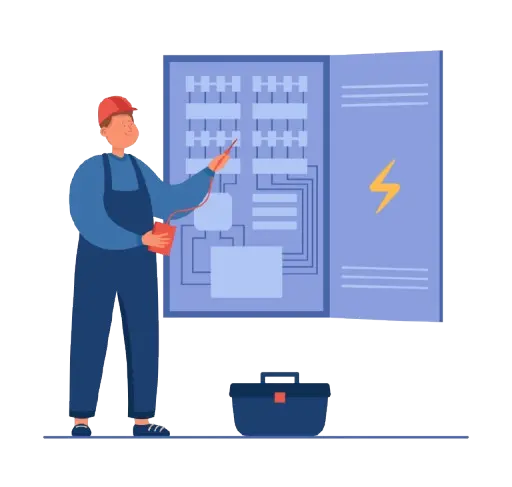
A Domestic EICR — Electrical Installation Condition Report is a formal inspection and test of a property’s fixed electrical installation, carried out by a qualified electrician against the BS 7671 Wiring Regulations (18th Edition, most recently amended 2022). At the end of testing, the property receives a result of either Satisfactory or Unsatisfactory, with any defects recorded and coded by severity.
In practice, most homeowners only encounter the term “EICR” when a mortgage lender, letting agent, or insurer asks for one so it helps to understand what the report actually measures before you book. It isn’t a cosmetic check. It’s a technical assessment of whether your wiring, sockets, consumer unit, and earthing are safe to keep using, and whether they meet the standard expected of a modern installation.
£79
1-3 Bedroom
£94
4 Bedroom
£104
5 Bedroom
£114
6+ Bedroom
£124
An EICR examines the condition of everything permanently connected to your electrical system: the consumer unit (fuse board), the cables running through walls and floors, sockets, switches, and light fittings. It does not test portable appliances like kettles or lamps that’s covered by a separate PAT Testing service.
During testing, an inspector checks for damage, deterioration, incorrect wiring, absence of earthing or bonding, and overloaded circuits; the specific test types are covered in full further down this page. The report itself is a legal document: it can be requested by tenants, local councils, insurers, or mortgage valuers as proof the property’s electrics are safe.
These two terms are used interchangeably in the UK property market, and both refer to the same document — a valid EICR is the electrical safety certificate landlords are legally required to hold. If a letting agent or council asks for your “landlord electrical safety certificate,” see our dedicated Landlord Electrical Safety Certificate page for the full legal breakdown.
Every EICR booking includes the full visual and technical inspection described later on this page, a digital PDF report delivered within 24 hours, and a written, itemised quote for any remedial work identified with no obligation to use Safety Spectrum London for the repairs themselves. If defects are found, see our EICR Remedial Work page for how the repair process works.
The prices above cover a property with a single consumer unit. If your property has more than one fuse board — common in converted flats or extended houses — this will be confirmed and quoted before your appointment. If your consumer unit itself needs replacing rather than just testing, see our separate Fuse Box Installation service.
The cost of not staying compliant is rarely just one certificate. Landlords often need more than an EICR within the same compliance cycle — from PAT Testing on furnished-let appliances to Emergency Lighting Certificates on HMOs and communal areas. Because Safety Spectrum London delivers these services in-house, booking more than one certificate at once often means a single engineer visit and combined pricing. Ask about bundling when you book.
Not everyone needs an EICR for the same reason, and the urgency differs sharply depending on whether you’re a landlord, a homeowner, or somewhere in between. Understanding which category you fall into determines both how often you need testing and what happens if you skip it.
Since 1 June 2020, the Electrical Safety Standards in the Private Rented Sector (England) Regulations have required landlords to have their electrical installations inspected and tested at least every five years. A copy of the report must go to tenants within 28 days of the inspection, and to the local authority within 7 days if requested. Non-compliance can result in enforcement action and fines of up to £30,000 — for the full breakdown of landlord duties, see our Landlord Electrical Safety Certificate page.
There’s no legal obligation for owner-occupiers, but the guidance most electricians work recommends testing every 10 years for private homes — and sooner for older properties, after major renovation work, or if you’ve noticed warning signs like flickering lights or warm sockets. What we see most often with older London properties — Victorian conversions especially — is wiring that was safe when installed but has quietly aged past the point of meeting current standards. If you’re already experiencing symptoms rather than testing preventatively, our Electrical Diagnostic service is the faster route to a direct fix.
A recent Satisfactory EICR is not mandatory when selling a home, but it removes one of the most common points of delay in conveyancing: a buyer’s surveyor flagging the electrics as “unknown condition” and requesting further checks mid-transaction.
For agents managing multiple properties on behalf of landlords, the challenge is rarely understanding the requirement it is tracking renewal dates across a portfolio. Safety Spectrum London works directly with agents to schedule renewals ahead of expiry, avoiding the last-minute compliance gaps that create liability for both agent and landlord.
At Safety Spectrum London, we deliver all types of EICR testing and certification your one trusted team for complete electrical safety compliance.
We offer professional EICR testing for offices and commercial sites, ensuring your business stays fully compliant with minimal disruption.
We deliver quick, accurate electrical fault-finding to identify issues early and prevent costly repairs or system failures in London.
We offer reliable emergency lighting inspections and certification to ensure your building meets all legal and safety standards.
We provide modern, compliant fuse box upgrades that enhance safety, reduce tripping, and meet all 18th-Edition regulations.
We provide fast, efficient PAT testing with instant digital reports to keep your appliances, staff, and tenants fully protected.
Beyond the legal requirement, there’s a simpler reason EICRs exist: electrical faults are genuinely dangerous, and most of the danger is invisible until something fails.
Electrical Faults as a Leading Cause of House Fires: Electrical faults are consistently reported among the leading causes of accidental house fires in the UK, and the underlying issues — degraded insulation, loose connections, overloaded circuits — rarely show visible warning signs before they become dangerous. An EICR exists specifically to catch these risks while they’re still fixable.
Protecting Your Insurance Position: Many household and landlord insurance policies now expect evidence of electrical safety as a condition of cover, particularly following an electrical incident. An expired or missing EICR can complicate a claim at exactly the moment you need your insurer to act quickly.
The Real Cost of Non-Compliance for Landlords: Beyond the £30,000 maximum fine under the 2020 regulations, non-compliant landlords risk rent repayment orders and difficulty enforcing tenancy agreements. The cost of a £79–£124 inspection is negligible against these risks, which is why most experienced landlords treat EICR renewal as a fixed annual budget line rather than an occasional afterthought.
This is the part of the process most customers know least about — understandably, since it’s technical by nature. Here’s what actually happens, in plain terms.
Visual Inspection: The engineer begins with a visual check of the consumer unit, sockets, switches, and any accessible cabling, looking for damage, overheating, incorrect labelling, or signs of DIY work that hasn’t been properly certified.
Dead Testing — Continuity, Ring Circuits & Insulation Resistance: With the relevant circuit safely isolated, the engineer tests continuity of protective conductors, checks that ring circuits form a genuine unbroken loop, and measures insulation resistance to confirm cables haven’t degraded internally. For a full standalone test of your fixed wiring outside of a certificate context, see our Fixed Wire Testing service.
Live Testing — Earth Loop Impedance & Fault Current: Once dead testing is complete, the engineer re-energises the circuit and measures earth fault loop impedance (Zs) confirming that if a fault occurred, the protective device would disconnect the circuit quickly enough to prevent harm.
RCD Testing & Shock Protection:Where Residual Current Devices are fitted, the engineer checks their trip time and sensitivity against BS 7671 requirements. An RCD that’s present but not functioning correctly gives a false sense of protection.
Earthing & Bonding Verification: Finally, the engineer verifies the main earthing conductor and the bonding connections to incoming gas and water pipework — one of the most commonly overlooked defects in older properties.
We make compliance effortless. Booking your EICR test in London with Safety Spectrum is quick, convenient, and completely transparent.
Call us or fill out our online booking form to get a price estimate instantly based on your property type.
Choose a time convenient to you: morning, afternoon, or evening. Our engineers will arrive on time and work efficiently around your schedule.
After the test, we email your digital EICR report, along with any recommended remedial actions, within 24 hours.
Once testing is complete, every finding is recorded against a standard coding system — understanding these codes in advance removes most of the anxiety around receiving your report.
Code | Meaning | Action Required |
C1 | Danger present | Immediate — made safe on-site where possible |
C2 | Potentially dangerous | Urgent — within 28 days for rented properties |
C3 | Improvement recommended | Not mandatory, advised for best practice |
FI | Further investigation needed | Confirmed before a final result is issued |
A report is only marked Satisfactory when there are zero C1, C2, or FI codes outstanding.

We provide Complete EICR inspections across:
What Happens If My EICR Is Unsatisfactory?
An Unsatisfactory result isn’t a failure in the way people sometimes assume — it simply means defects were found that need addressing. In our experience, most Unsatisfactory results come from one or two specific issues, not a wholesale rewiring need.
How Remedial Work Is Quoted and Carried Out: Where remedial work is needed, Safety Spectrum London provides a clear, itemised, no-obligation quote full detail on this process is on our EICR Remedial Work page. For general repairs beyond EICR remedials, see Electrical Repairs & Installation.
There are dozens of EICR providers across London here is specifically what sets Safety Spectrum London apart.
NICEIC-Approved, Fully Insured Engineers: Every inspection is carried out by a NICEIC-approved electrician, working to full public liability insurance cover — the same accreditation standard referenced by mortgage lenders and most UK insurers as evidence of a competent inspection. Meet our full team on the Electricians London page.
London-Wide Experience Across Flats, HMOs & Period Properties: From Victorian conversions in Hackney to new-build developments in Nine Elms, London’s housing stock varies enormously — our engineers work across all of it daily.
Transparent, Plain-English Reporting: Your report explains what was found and why it matters, not just a list of codes.
Same-Day and Urgent Appointments: Where a deadline is approaching, same-day appointments are available in most boroughs.
Ensure your home’s safety today with Safety Spectrum London.
Our experienced engineers are ready to help you meet all electrical compliance requirements.
A Residential or Domestic EICR (Electrical Installation Condition Report) is a formal document confirming that your property’s electrical system is safe and compliant with BS 7671 Wiring Regulations.
Usually between 1–3 hours, depending on the property size and number of circuits.
For landlords, yes it’s a legal requirement every 5 years or at the start of a new tenancy. For homeowners, it’s not mandatory, but strongly recommended for safety and insurance compliance.
Yes as long as the electrician is NICEIC-approved and qualified in inspection and testing, they can perform and certify an EICR.
Every 10 years for owner-occupied homes, and every 5 years for rental properties (or sooner if advised by your engineer).
If faults or non-compliances are found, our engineers provide a clear list of issues, explain the risk codes (C1, C2, FI), and issue a no-obligation quote for remedial work. Once repairs are complete, a new “Satisfactory” EICR is issued.
Yes. Providing an up-to-date EICR increases buyer confidence, supports conveyancing requirements, and can help speed up property sales.
Absolutely. Older homes benefit the most from EICRs as they often contain outdated wiring or components that no longer meet safety standards.
All reports are issued digitally within 24 hours of inspection. You’ll receive a professional, PDF EICR report by email suitable for insurance or council submission.
Yes. Safety Spectrum London offers same-day and urgent appointments across all London boroughs and Greater London areas.


© 2026 Safety Spectrum London – All Rights Reserved. Company Reg No.16678881
Live Chat