
PAT Testing London | Safety Spectrum London — NICEIC-Certified Engineers
Fast, Fully Insured PAT Testing Across All London Boroughs
Safety Spectrum London provides fully insured Portable Appliance Testing (PAT Testing) for landlords, offices, schools and businesses across every London borough. If you have searched for “PAT testing near me” or “PAT test near me,” our qualified electricians are NICEIC-registered and City & Guilds 2377 qualified, and every job includes a written test certificate, no hidden call-out fees, and no extra charges for congestion or ULEZ zones. As one of the leading PAT testing companies serving London, we can usually get an engineer to you within 24–48 hours whether you need a single flat test before a new tenant moves in or a full commercial PAT testing service for a site with hundreds of appliances.
Residential PAT Cost in London
Up to 10 Items
£59
10-20 Items
£79
20-40 Items
£89
Commercial PAT Cost in London
Up to 10 Items
£79
10-20 Items
£99
20-40 Items
£109
What Our Client Say About Us
EXCELLENT Based on 10 reviews
 Posted on Google
 Viktoria RybchynskaGood and fast work! Fire door and certification! Recommend 👌Posted on Google
 jackie cookeQuick to respond to emails, work booked in within a week and well priced. Tenant happy with the person who completed the PAT test. Highly recommendPosted on Google
 synymyrGrade D LD1 smoke alarm system installed. Excellent customer service from Haider and Syed, and a dedicated and careful installation by electrical engineer William. A reduced invoice was volunteered when 3 existing smoke alarms were able to be integrated into the job. A young company, but proficient, assiduous and with clear, timely communication. Highly recommend.Posted on Google
 DEBEE LAYCOCKVery helpful, well informed assessor. Excellent service, reasonable pricing. We will use this company again for our rental properties.Posted on Google
 Salma SaidI needed the service fast. And they booked me for the next day. Happy with the service.Posted on Google
 J1Great communications (friendly and responsive over WhatsApp), flexible (was able to fit us in at short notice), and good value (compared to some other quotes I received). I would recommend for anyone needing an efficient FRA.Posted on Google
 John WeekendsaGood quality and service. Very easy communication with management and highly skilled engineers.Posted on Google
 Clement MegueuleI arranged an EPC inspection through this company and was very happy with the experience. The engineer who attended was friendly and professional, thank you. As a private landlord, it’s great to work with a reliable company and not to deal with any issues. I would definitely recommend them and thanks Haider again.Posted on Google
 Yevheniia PohorielovaGreat service! Prompt, reliable, and very professional. The team is friendly and easy to deal with and they always complete gas safety and EICR inspections efficiently. In my experience they are one of the best companies in London for landlords and property management. Highly recommended.
What Is PAT Testing?
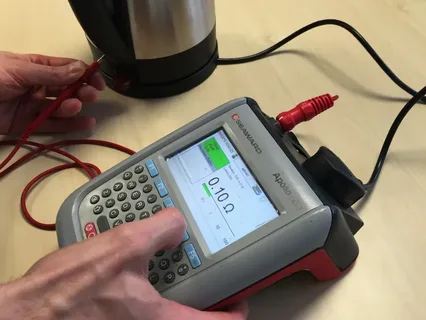
PAT testing (Portable Appliance Testing) is the inspection and testing of electrical appliances to confirm they are safe to use in other words, the process by which an appliance is “PAT tested.” It combines a visual check of the plug, cable and casing with a series of electrical tests earth continuity, insulation resistance and polarity carried out using calibrated PAT testing equipment. Appliances are then labelled pass or fail, and a certificate is issued confirming the results.
PAT Meaning and What “PAT” Stands For
PAT stands for Portable Appliance Testing. The PAT testing definition, in simple terms, is a safety check on any electrical item with a plug from a kettle to a laptop charger to confirm it’s safe to keep using. “PAT tested” simply means an appliance has been through this inspection and passed.
Why It is Now Also Called “EET Testing” (IET 5th Edition)
Under the IET Code of Practice, 5th Edition, the industry term has officially shifted from “Portable Appliance Testing (PAT)” to “In-Service Inspection and Testing of Electrical Equipment,” often shortened to EET Testing. The change reflects that not all tested items are strictly portable; some are stationary or fixed. In practice, “PAT Testing” remains the term almost everyone searches for and uses day-to-day, so we use both interchangeably. What matters is that the underlying inspection standard is the same one your certificate will be tested against.
We Offer Complete EICR Service Options in London
At Safety Spectrum London, we deliver all types of EICR testing and certification your one trusted team for complete electrical safety compliance.
Commercial EICR
We offer professional EICR testing for offices and commercial sites, ensuring your business stays fully compliant with minimal disruption.
Electrical Diagnostics
We deliver quick, accurate electrical fault-finding to identify issues early and prevent costly repairs or system failures.
Residential EICR
We provide fast, certified electrical inspections for homes and rentals, ensuring complete safety and compliance at competitive rates.
Fuse Box Installation
We provide modern, compliant fuse box upgrades that enhance safety, reduce tripping, and meet all 18th-Edition regulations.
Emergency Lighting Certificate
We offer reliable emergency lighting inspections and certification to ensure your building meets all legal and safety standards.
What is Included (No Hidden Fees)
Every booking, regardless of size, includes: free minor repairs (standard fuse and plug replacement see our fuse box installation service if a full replacement is needed), pass/fail labelling on every appliance tested, a digital certificate and asset register emailed within 24 hours, and a free re-test reminder before your next renewal is due. There is no separate charge for testing outside the M25 congestion zone, and no weekend surcharge for standard bookings.
Our Certifications
- NICEIC Approved Contractor — independently assessed against national wiring and testing standards
- City & Guilds 2377 PAT Testing Qualification — the recognised industry qualification for PAT/EET testing competence
- DBS-Checked — every engineer is background-checked before entering your property
- £5 million Public Liability Insurance — full cover on every job
Our approach follows HSE PAT testing guidance throughout. We do not cut corners on the visual inspection stage just because the electrical test passed.
Our PAT Testing Process
All tests performed comply with written RAMS (Risk Assessment & Method Statement) for total HSE compliance.
Visual Inspection
We begin by carefully inspecting each appliance for any visible signs of damage, exposed wires, or unsafe connections.
Electrical Testing
Using calibrated PAT testing equipment, we check for earth continuity, insulation resistance, and polarity to ensure each appliance meets safety standards.
Labelling and Asset Identification
Each tested appliance receives a clear PASS or FAIL label, along with the test date, engineer ID, and a unique barcode to track and log each item accurately.
Digital Report and Certificate
Within 24 hours, we issue a detailed digital PAT Test Certificate and report listing all tested items, complete with readings for compliance and record-keeping.
Free Retest Reminder
We log your next test due date in our system and send you automated reminders so you stay compliant without worrying about missed deadlines.
PAT Testing Class | Description | Examples | PAT Test Performed |
Class 1 – Earthed Appliances | Appliances that rely on an earth connection to protect users from electric shock. | Kettles, toasters, washing machines, desktop computers, refrigerators | Visual inspection, earth continuity test, insulation resistance test (or substitute test), and functional check. |
Class 2 – Double-Insulated Appliances | Appliances with double or reinforced insulation that do not require an earth connection. | Hairdryers, power drills, most modern TVs, table lamps | Visual inspection, insulation resistance test (or substitute test), and functional check. No earth continuity test is required. |
Class 3 – Low-Voltage Appliances | Appliances designed to operate at a safe extra-low voltage (SELV), typically below 50V AC or 120V DC, presenting a very low risk of electric shock. | Laptops, mobile phone chargers, low-voltage LED lighting, battery-powered devices | Visual inspection and functional check. Full PAT testing is generally not required due to the low operating voltage. |
How Often Should PAT Testing Be Done? (PAT Testing Frequency)
There’s no single legal interval — the right frequency depends on the type of equipment, how often it’s used, and the environment it’s in. The table below follows IET Code of Practice guidance.
Environment | Class 1 (stationary/IT) | Portable/handheld |
Offices & Shops | Every 48 months | Every 12–24 months |
Construction Sites (110V) | Every 3 months | Every 3 months |
Industrial Environments | Every 12 months | Every 6 months |
Schools | Every 12 months | Every 12 months |
Public-Use Premises | Every 6–12 months | Every 6 months |
These are guideline intervals, not fixed legal deadlines. A proper risk assessment should confirm the right schedule for your specific site.

Book Professional PAT Testing in London
If you manage property in London and want clear, reliable and professionally documented PAT testing, we are ready to help.
Is PAT Testing a Legal Requirement in London? (PAT Testing Regulations UK)
Strictly speaking, no single law says “you must PAT test every appliance every year.” What PAT testing regulations in the UK do say is that employers and landlords must keep electrical equipment in a safe condition and PAT testing is the standard, recognised way of meeting that requirement. The key PAT testing requirements come from:
- The Health and Safety at Work Act 1974 — places a general duty of care on employers and landlords
- The Electricity at Work Regulations 1989 — requires electrical equipment to be maintained to prevent danger
- The Provision and Use of Work Equipment Regulations 1998 (PUWER) — requires work equipment to be maintained in efficient working order
If an accident happens and you can’t show any record of testing or maintenance, you may struggle to defend a claim and some insurers will reject a claim outright if equipment hasn’t been properly maintained. For more detail on certification and legal obligations, see our full electrical safety certificate FAQ.

PAT Testing vs EICR — What is the Difference?
These two certificates are often confused, but they cover different things.
PAT Testing | ||
What it covers | Portable/plug-in appliances (kettles, laptops, extension leads) | Fixed wiring, sockets, consumer unit, distribution boards |
Typical frequency | 1–4 years, depending on risk | Every 5 years (rental), or on change of tenancy |
Who needs it | Anyone supplying plug-in equipment | Landlords, and businesses with fixed electrical installations |
Certificate name | PAT Test Certificate | Electrical Installation Condition Report |
Many landlords and businesses book both together in a single visit, since one engineer can usually complete both while on site asking us about combined pricing on our residential EICR or commercial EICR pages. If your EICR comes back with issues, we also carry out EICR remedial work to fix them.
Who Needs PAT Testing?
Landlords & HMOs: If you supply any electrical appliances with rental property kettles, microwaves, lamps you have a duty of care to ensure they’re safe. This is especially important in HMOs, where shared kitchen and communal appliances see heavier use. See our dedicated landlord electrical safety certificate page for the full compliance picture beyond PAT testing alone.
Offices: Desktop computers, monitors, printers, kettles and chargers are the most commonly tested items in office environments. Regular testing also supports your wider health and safety policy and insurance compliance.
Schools & Colleges: Educational sites often have a mix of classroom IT equipment, science lab devices, and canteen appliances all used by large numbers of people daily. We offer term-time-friendly scheduling, including evenings, weekends and school holidays.
Construction Sites: 110V and 3-phase site tools need testing every 3 months under IET guidance, given how frequently they’re moved, dropped and exposed to the elements.
Hospitality And Retail: Kitchen equipment, POS systems, and customer-facing appliances in restaurants, cafes and shops all fall under PAT testing scope particularly relevant given how often these items are handled by staff and the public.
Areas We Cover in London (M25 And Surrounding)
We provide PAT testing across every London postcode zone, plus the M25 commuter belt. Below is our full coverage area, grouped by zone with postcodes — only areas with a dedicated Safety Spectrum London page are linked; the rest are covered as standard by our engineers.
Central London — W1, WC1, WC2, EC1–EC4, SW1
Including Westminster, City of London, Holborn, Covent Garden, Soho, Mayfair, Marylebone, Fitzrovia, Bloomsbury, St James’s, Pimlico, South Bank, Victoria, Belgravia, Knightsbridge, Chelsea, Kensington, Paddington, Bayswater and Notting Hill.
North London — N1–N22
Covering Barnet, Enfield, Haringey, Camden and Islington, including Highgate, Muswell Hill, Crouch End, Finsbury Park, Archway, Hampstead, Golders Green, Finchley, Mill Hill, Totteridge, Whetstone, Barnet, Enfield Town, Palmers Green, Winchmore Hill, Southgate, Edmonton, Bounds Green, Wood Green, Alexandra Palace, Holloway and Islington.
North West London — NW1–NW11, HA1–HA9
Covering Brent, Harrow, Camden and parts of Barnet and Ealing, including Cricklewood, Kilburn, Willesden, Neasden, Harlesden, Wembley, Alperton, Kingsbury, Queensbury, Kenton, Harrow, Pinner, Ruislip, Stanmore, Edgware, Colindale, Hendon, Brent Cross and Swiss Cottage.
West London — W3–W13, UB1–UB11, TW3–TW8
Covering Hammersmith & Fulham, Ealing, Hounslow and Hillingdon, including Acton, Chiswick, Ealing, Hanwell, Hammersmith, Shepherd’s Bush, White City, Holland Park, Southall, Brentford, Isleworth, Hounslow, Osterley, Feltham, Hayes, Harlington, Uxbridge, Ruislip, Yiewsley and West Drayton.
South West London — SW11–SW20, KT1–KT6, TW1–TW2, TW11–TW12
Covering Wandsworth, Richmond, Kingston and Merton, including Putney, Wandsworth, Clapham Junction, Battersea, Balham, Tooting, Earlsfield, Southfields, Wimbledon, Raynes Park, Morden, Colliers Wood, Mitcham, Streatham, Norbury, Richmond, Twickenham, Teddington, Hampton, Kingston upon Thames, Surbiton and New Malden.
South London — SW2, SW4, SW9, SE1–SE27, CR0–CR8
Covering Lambeth, Southwark and Croydon, including Brixton, Clapham, Stockwell, Vauxhall, Kennington, Elephant & Castle, Camberwell, Peckham, Dulwich, Herne Hill, Crystal Palace, Norwood, Thornton Heath, Croydon, Addiscombe, Shirley and Selhurst.
South East London — SE2–SE28, DA1–DA18, BR1–BR8
Covering Lewisham, Greenwich, Bexley and Bromley, including Deptford, New Cross, Brockley, Lewisham, Catford, Hither Green, Blackheath, Greenwich, Eltham, Woolwich, Plumstead, Abbey Wood, Thamesmead, Bexleyheath, Welling, Sidcup, Chislehurst, Bromley, Beckenham, Orpington, Penge, Anerley and Grove Park.
East London — E1–E20, IG1–IG11, RM1–RM20
Covering Hackney, Tower Hamlets, Newham, Barking & Dagenham, Redbridge, Havering and Waltham Forest, including Shoreditch, Hoxton, Bethnal Green, Whitechapel, Stepney, Poplar, Bow, Canary Wharf, Stratford, Forest Gate, Plaistow, East Ham, West Ham, Canning Town, Beckton, Barking, Dagenham, Ilford, Seven Kings, Goodmayes, Chadwell Heath, Romford, Gidea Park, Hornchurch, Upminster, Wanstead, Leyton, Leytonstone, Walthamstow, Chingford and Woodford Green.
M25 Commuter Belt (Outside London, Still Covered)
We also serve the surrounding commuter belt just outside the M25: Watford, Bushey, Borehamwood, Elstree, Potters Bar, Cheshunt, Waltham Abbey, Epping, Loughton, Theydon Bois, Chigwell, Buckhurst Hill, Brentwood, Dartford, Swanley, Epsom, Ewell, Leatherhead, Ashford (Middlesex), Staines-upon-Thames, Sunbury, Shepperton, Rickmansworth and Chorleywood.
Real Results — Case Studies
Case Study 1 — HMO Letting Agency, East London: A letting agency managing a portfolio of HMO properties across East London needed PAT testing completed ahead of a licensing renewal deadline. We tested appliances across the full portfolio within a single week, flagging a small number of failed items — mostly damaged extension leads which were repaired free of charge on-site. A full digital asset register was delivered within 24 hours, in time for the renewal.
Case Study 2 — Independent Restaurant Group, Central London: A multi-site restaurant group needed all kitchen and front-of-house equipment tested without closing during service. We scheduled testing before opening hours across a single week, completing every site with zero disruption to trading.
Case Study 3 — Primary School, North London: Working around term-time constraints, we completed a full-site test covering classroom IT, science lab equipment and canteen appliances during a single weekend, delivering documentation in time for the school’s safety review.
PAT Testing vs EICR – Understanding the Difference
These services address different aspects of electrical safety.
Portable appliances versus fixed wiring:Portable Appliance Testing focuses on plug-in equipment. EICR assesses fixed installation wiring.
Scope of inspection and level of testing:PAT is appliance-specific. EICR involves inspection of circuits, consumer units and distribution systems.
When both services may be required:Landlords and commercial property owners often require both to demonstrate comprehensive electrical compliance.
Coordinating electrical compliance services efficiently:We can advise on aligning inspection schedules to reduce disruption.
Download Our Free PAT Testing Compliance Checklist
Not ready to book yet? Download our free one-page PAT Testing Compliance Checklist — a simple guide to what needs testing, how often, and what your certificate should include. No obligation, just useful.
Frequently Asked Questions (FAQ)
What is PAT Testing and why is it needed?
PAT Testing ensures that your electrical appliances are safe to use. It significantly reduces the risk of electric shocks, electrical fires, and other hazards.
How long does PAT Testing take?
Most appointments take between 1 and 3 hours, depending on the number of appliances and the size of the property.
Is PAT Testing a legal requirement?
While not strictly mandatory, PAT Testing helps you comply with the Electricity at Work Regulations 1989 and is often required by insurers and regulators.
How often should appliances be tested?
Offices: every 24 monthsHigh-risk environments: every 6–12 monthsRental properties (landlords): every 12 months
What happens if an appliance fails the test?
It will be clearly marked with a “Fail” label, included in your report, and our engineer will advise whether the item should be repaired or replaced.
Who can carry out PAT Testing?
Only a competent person—trained under City andGuilds 2377 and using calibrated equipment—is qualified to carry out PAT Testing.
Do you offer same-day PAT Testing in London?
Yes. We offer same-day and next-day bookings across all London boroughs, including evenings and weekends.
Are new appliances required to be tested?
New appliances should be given a visual inspection before first use and included in the next scheduled testing cycle.
Do you offer discounts for multiple properties or agencies?
Yes. We offer reduced rates for landlords, estate agents, and facilities managers handling multiple properties or sites.
What is PAT testing equipment?
PAT testing equipment refers to the calibrated devices engineers use to run electrical safety checks — testing earth continuity, insulation resistance and polarity — rather than relying on a visual check alone.
Accreditations and Compliance Guarantee


