If you own, let, or manage a property in London, you are almost certainly going to need an EICR certificate an Electrical Installation Condition Report at some point, whether that’s a legal requirement as a landlord, a request from your mortgage lender, or simply peace of mind before you move in. Safety Spectrum London is a NICEIC-only accredited electrical safety specialist based in Hayes, providing EICR certificates across London for landlords, homeowners, letting agents, and businesses. If you’re specifically after our dedicated landlord electrical safety certificate service, that page covers portfolio and multi-property support in more depth.
Residential EICR Cost in London
Studio
£79
1-3 Bedroom
£94
4 Bedroom
£104
5 Bedroom
£114
6+ Bedroom
£124
An EICR is a formal inspection of a property’s fixed electrical installation the wiring, consumer unit, sockets, switches, and permanently connected equipment carried out by a qualified electrician against the BS 7671 wiring regulations (the IET’s national standard for electrical installations). It isn’t a check of your appliances or your décor; it’s a technical assessment of whether the electrics behind your walls are safe to keep using as they are.
The reason it matters goes beyond box-ticking. Faulty or deteriorating wiring is a genuine fire and shock risk, and it’s often invisible until something goes wrong. An EICR exists to catch that before it becomes an emergency, giving you a written, dated record that a competent person has actually looked at the installation and confirmed its condition or flagged exactly what needs fixing.
The report itself sometimes called an electrical installation condition report certificate is a structured document, not just a pass/fail slip. It records the property details, the scope of what was and wasn’t tested, a full schedule of test results for each circuit, and a list of any observations with a severity code attached. In practice, this is the document your letting agent, mortgage lender, or local council will actually ask to see so its accuracy and clarity matter as much as the inspection itself. You may also see this referred to simply as an electrical installation condition report EICR, or a BS7671 electrical safety certificate, since the inspection is carried out and reported against that specific standard.
It’s a common point of confusion, so it is worth being direct about it: an EICR and a PAT test are not the same thing, and one doesn’t replace the other. An EICR covers the fixed electrical installation the wiring, the consumer unit, the sockets themselves. Portable Appliance Testing (PAT) covers the things you plug into those sockets kettles, washing machines, portable heaters. A furnished rental property with an HMO licence may well need both; an EICR alone won’t cover appliance safety, and vice versa.
It is easy to think of an EICR as a paperwork exercise, but in practice it’s the only formal moment where someone qualified actually opens the consumer unit and tests the circuits rather than just looking at them. We have seen properties where everything looked fine on the surface no visible damage, lights working, sockets working and testing still turned up a dangerous earthing fault that no amount of visual inspection alone would have caught. That is the whole point of the test-based approach over a simple walk-through.
Faulty electrics are consistently one of the leading causes of accidental house fires in the UK, and the risk rises with the age of a property’s wiring which, given how much of London’s housing stock predates modern wiring standards, is a real and current issue rather than a historical one.
At Safety Spectrum London, we deliver all types of EICR testing and certification your one trusted team for complete electrical safety compliance.
We offer professional EICR testing for offices and commercial sites, ensuring your business stays fully compliant with minimal disruption.
We deliver quick, accurate electrical fault-finding to identify issues early and prevent costly repairs or system failures.
We provide fast, certified electrical inspections for homes and rentals, ensuring complete safety and compliance at competitive rates.
We provide modern, compliant fuse box upgrades that enhance safety, reduce tripping, and meet all 18th-Edition regulations.
We offer reliable emergency lighting inspections and certification to ensure your building meets all legal and safety standards.
We provide fast, efficient PAT testing with instant digital reports to keep your appliances, staff, and tenants fully protected.
Whether an EICR is a legal requirement, a strong recommendation, or something in between depends entirely on what kind of property you have and how it’s used and getting this wrong is one of the most common (and costly) mistakes we see.
If you rent out a property in England, the Electrical Safety Standards in the Private Rented Sector (England) Regulations 2020 make an EICR a legal requirement, not a suggestion. You must have a valid, satisfactory EICR carried out by a qualified person at least every five years, and at the start of any new tenancy. Once it is done, you are required to give a copy to your existing tenants within 28 days, and to any new tenant before they move in. If your local authority asks for a copy, you have seven days to provide it.
If you own and live in your own home, there’s no legal obligation to have a residential EICR carried out but it is still widely recommended every ten years, or sooner if you are planning significant renovation work, buying an older property, or simply have not had one done in living memory. Mortgage lenders and conveyancing solicitors will very often ask for a recent EICR as part of a sale, so it’s worth having one ready rather than scrambling for one mid-transaction.
Commercial premises sit under a different framework the Electricity at Work Regulations 1989 — which places a general duty on business owners to keep electrical systems safe, and a satisfactory EICR is the standard way of demonstrating that. Most commercial properties are inspected every five years, though higher-risk environments such as industrial units, or premises with heavy equipment use, are often inspected every three years instead.
Businesses with more complex or multi-circuit installations may benefit from our dedicated commercial EICR service, tailored to larger-scale premises.
What Happens If You Do not Have a Valid Certificate
For landlords specifically, not having a valid EICR is not a minor administrative slip local authorities have the power to issue civil penalties, and in the most serious cases these can run into the tens of thousands of pounds per breach. Beyond the direct financial risk, an expired or missing EICR can also complicate insurance claims following an electrical incident, since insurers increasingly expect to see evidence of routine testing as a condition of cover.
The practical takeaway: if you’re not certain your current EICR is still valid, or you have made any electrical changes to the property since it was last tested, it’s worth checking before it becomes a bigger problem than a routine inspection would have been.
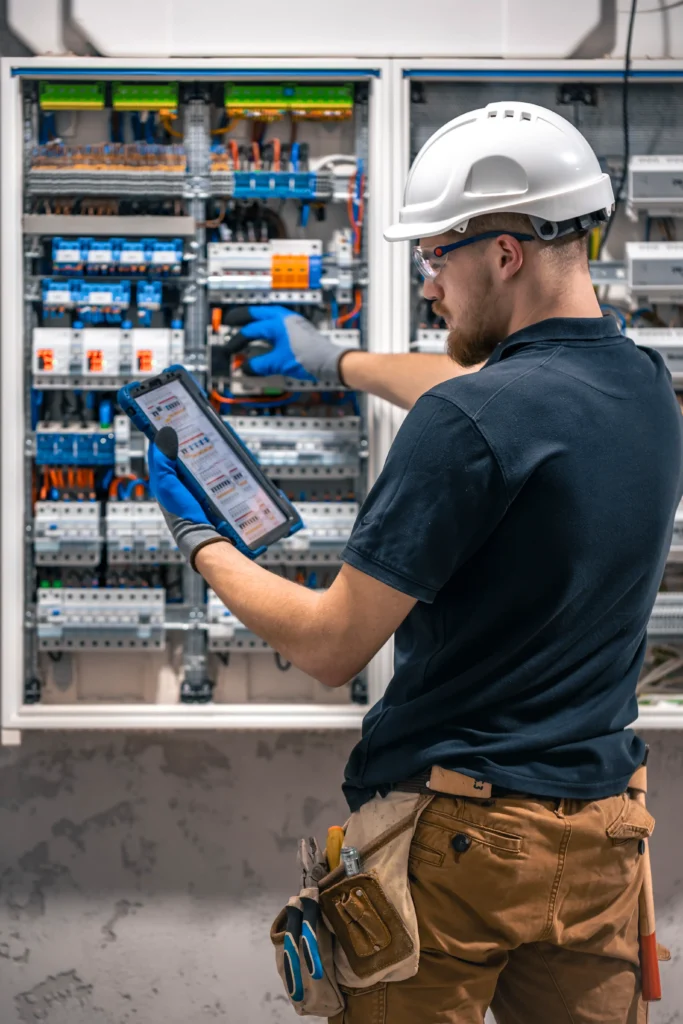
An EICR inspection isn’t a single test — it’s a structured sequence of checks, each covering a different aspect of the installation’s safety. Here’s what our engineers actually do on site.
Visual Inspection of Your Electrical Installation: Before any testing begins, the engineer carries out a thorough visual check of the consumer unit, sockets, switches, and visible wiring, looking for obvious signs of damage, wear, overheating, or non-compliant work. This stage often catches issues that are immediately apparent: cracked sockets, scorch marks, or an outdated fuse board in need of a fuse box upgrade before any instrumented testing even starts.
Dead Testing Continuity, Insulation Resistance and Polarity: With the power isolated, the engineer runs a set of dead tests: checking that protective conductors are correctly connected (continuity), that insulation around the wiring is intact and hasn’t degraded (insulation resistance), and that the wiring is connected the right way around (polarity). These tests catch faults that simply aren’t visible from the outside — deteriorated insulation, in particular, is a common finding in older London properties that otherwise look perfectly normal.
Live Testing and Earth Fault Loop Impedance: Once dead testing is complete, the power is restored and the engineer measures earth fault loop impedance essentially confirming that if a fault does occur, the circuit will disconnect quickly enough to prevent a shock or fire, rather than allowing a dangerous fault current to keep flowing.
RCD Testing and Final Circuit Checks: Finally, any Residual Current Devices (RCDs) the safety switches designed to cut power instantly if they detect a fault are tested to confirm they trip within the required time. On larger or commercial installations, we also record supply characteristics (Ze and PSC measurements) and check any Surge Protection Devices fitted to the consumer unit. This is one of the most important checks in the whole inspection, since a non-functioning RCD can mean the difference between a minor fault and a serious shock. This full sequence is sometimes referred to by its older name, fixed wire testing, and the two terms describe the same process the end result in both cases is your EICR report, with every circuit’s test results recorded against it.
Once testing is complete, any issues found are recorded against a standard set of severity codes. Understanding what these actually mean and what they mean for your timeline and budget matters more than just knowing the definitions.
C1 — Danger Present and Immediate Risk: A C1 finding means there’s an immediate risk of injury — exposed live parts, for example, or severely damaged wiring. This is the only code that typically requires action on the spot; a competent engineer will usually make the specific issue safe there and then, before leaving the property, rather than leaving a known danger in place until a follow-up visit.
C2 — Potentially Dangerous Findings: A C2 finding doesn’t mean immediate danger, but it does mean something could become dangerous if left unaddressed a missing RCD on a circuit that needs one, for example, or inadequate earthing. Under the Private Rented Sector Regulations, C2 issues must be remedied, typically within 28 days, with written confirmation provided to the tenant and, if requested, the local authority.
C3 — Improvements Recommended, Not Required: This is the code that causes the most unnecessary anxiety, so it’s worth being clear: a C3 finding does not make your EICR unsatisfactory. It means the installation doesn’t fully meet the very latest wiring standards, but isn’t unsafe as it stands think of it as closer to an MOT advisory than a fail. You are not legally required to act on C3 items, though addressing them over time is good practice.
FI — When Further Investigation Is Needed: An FI code means the engineer has spotted something that can’t be fully assessed without more detailed testing, inconsistent readings, or an area that could not be safely accessed on the day, for example. In these cases we can arrange a follow-up electrical diagnostic visit to isolate the exact cause. Until that investigation happens, the report can’t be marked satisfactory, so this is worth acting on promptly rather than letting it sit.
Costs for remedial work vary hugely depending on what’s actually found — a straightforward C2 like adding a missing RCD to a distribution board is a relatively minor job, while a C1 involving damaged wiring behind walls can mean more significant work. We always provide a clear, itemised quote for any EICR remedial work identified, broken down by finding, so you can see exactly what you’re paying for and why — and there’s no obligation to use us for the repair itself if you’d prefer to get your own quotes, though our own electrical repairs team can carry out the fix at the same visit where practical.
To avoid any confusion, it’s worth being clear about what an EICR isn’t. It doesn’t automatically include replacing accessories, consumer units, or wiring; fault-finding beyond the scope of the original inspection; portable appliance testing (unless booked alongside it); or decorative making-good after remedial works. If something outside the standard scope comes up, we’ll always explain it and price it separately before any work begins — not after.
An unsatisfactory result isn’t the end of the process — it’s simply the start of a clear, structured next step:
We keep things organised so you get a smooth booking, a proper inspection, and clear paperwork.
Choose a suitable time slot. For managed properties, we can coordinate with your agent or tenant.
Our engineer arrives on time and confirms access to: consumer unit, sockets and lighting points, bonded services .
Some testing requires brief power isolation. We keep disruption as low as possible and explain what’s happening.
You receive your EICR digitally, ready for: tenants, agents, councils, insurance records
If issues are found, we’ll provide a clear quote and help you plan the next steps quickly.
To avoid delays, ask tenants to:
This depends on size, circuit count, and access. Most domestic inspections take a few hours.
If needed, we can collect keys or work with site contacts so you don’t have to manage back-and-forth.
EICR costs in London typically range from around £79 for a small flat up to £250+ for a larger house, with commercial premises priced separately based on circuit count. The exact figure depends on your property’s size and the number of circuits on your consumer unit get in touch with your property details for a fixed, no-obligation quote.
It is a fair question, and one that’s surprisingly hard to get a straight answer to elsewhere a lot of electrical safety certificate London pricing online is vague, or buried behind a “request a quote” form with no indication at all. We had rather just tell you what actually drives the number.
What Affects the Price of Your EICR: Two things determine EICR certificate cost more than anything else:
Beyond that, access and parking (particularly relevant in central London boroughs with congestion charging or restricted parking) can occasionally factor into the final price — we’ll always flag this upfront rather than adding it as a surprise on the invoice.
Landlord EICR Cost — What to Budget For: If you are a landlord getting your electrical safety certificate for landlords sorted ahead of a new tenancy or a five-year renewal, the same size-and-circuit-count principle applies. Landlords managing more than one property should ask about our portfolio pricing — testing several properties in a single visit or over a short period is usually more cost-effective than booking each one separately, and we can align renewal dates across a portfolio to keep things simple.
Commercial EICR Cost: Commercial EICR cost is driven by the same principles but scales differently, since commercial premises typically have significantly more circuits and often multiple distribution boards. See our earlier note on commercial EICR testing above for how this applies to offices, retail units, and larger commercial premises.
What is Included in Every Inspection: Every inspection we carry out includes the full visual, dead, live, and RCD testing sequence described above, a complete written EICR delivered digitally, and — where anything is found — a clear, itemised quote for remedial work with no obligation attached. There are no hidden add-ons for the standard scope of testing; anything additional, such as extra consumer units, is priced transparently upfront.

NICEIC-Only Accreditation — What That Means for You: Safety Spectrum London holds NICEIC accreditation — and only NICEIC. That’s a deliberate choice rather than a limitation. Rather than spreading across multiple accreditation bodies, we’ve focused on being genuinely excellent within one recognised, independently audited standard, which means every inspection is carried out and reported to a single, consistent benchmark you can look up and verify directly with NICEIC.
Meet Our Qualified Electrical Engineers: Our engineers hold the relevant City & Guilds inspection and testing qualifications required to legally carry out EICRs, alongside hands-on experience across London’s varied housing stock from Victorian conversions to modern new-builds. In practice, that range of experience matters: the faults you find in a converted period property are rarely the same ones you find in a purpose-built flat, and knowing what to expect from each speeds up the inspection without cutting corners.
Honest Reporting, No Pressure on Remedial Work: We are upfront about something most providers in this space don’t address at all: there’s an obvious potential conflict of interest when the same company both tests your property and quotes for the repair work. We handle this by giving you a clear, itemised report and quote with no obligation to use us for any remedial work identified — if you’d rather get a second quote or use your own electrician, that’s entirely your choice, and it won’t affect the validity of the certificate we’ve issued.
Gas Safety, Fire Risk Assessments and EPC Requirements: An EICR is usually one part of a wider set of compliance obligations for London landlords, not the whole picture. Gas Safety Certificates, fire risk assessments (particularly relevant for HMOs), Energy Performance Certificates, and — for commercial premises especially — emergency lighting certification all sit alongside electrical safety as separate, distinct legal requirements with their own renewal cycles.
Building a Full Compliance Schedule for Your Property: Because these certificates run on different cycles five years for an EICR, one year for a Gas Safety Certificate, ten years for an EPC it’s easy to lose track of what’s due when, especially across a portfolio of properties. We work with landlords and agents to align these renewal dates where practical, so you’re not managing five separate reminder systems for what is, ultimately, one overall compliance responsibility.
Property Type | Recommended Frequency |
Owner-occupied homes | Every 10 years |
Rental properties | Every 5 years or at change of tenancy |
Commercial premises | Every 3–5 years |
Educational buildings | Every 5 years |
Hotels, care homes, public buildings | Every 3 years |
Industrial sites | Every 3 years |
Keeping Your Compliance Paperwork in Order: Good record-keeping matters as much as the inspection itself if questions ever come up later. As a landlord, it’s worth keeping: your latest EICR report; proof it was shared with tenants (and agents, where relevant) within the required timeframe; any remedial quotes and completed-work invoices; Minor Works Certificates, where issued; and confirmation of any re-inspection or follow-up testing. Local authorities can request your EICR directly, and having this paperwork organised avoids a stressful last-minute scramble if they do.
Where We Carry Out EICR Inspections in London
We cover the whole of Greater London, with dedicated local pages for each part of the capital: North London, East London, Central London, West London, and South London. If you are looking for a specific neighbourhood, our area pages cover local property types and access considerations in more detail.
Electrical safety and legal requirements do not have to cause anxiety to either business owners or domestic clients in particular, since at Safety Spectrum London, we make these processes quick, inexpensive, and carried out in a professional manner from start to finish.
We provide Complete EICR inspections across:
London buildings often include older wiring routes, converted flats, mixed-use blocks, and shared intakes. Our engineers are experienced in carrying out a thorough electrical safety check in these environments, ensuring minimal disruption for tenants and neighbours while maintaining full compliance.
If you need a reliable EICR in London, we’ll keep it simple: clear booking, professional testing, and fast certification.
For further questions beyond EICRs specifically, see our full electrical safety certificate FAQ hub.
An EICR (Electrical Installation Condition Report) is a formal inspection of a property's fixed electrical wiring, consumer unit, sockets, and switches, carried out by a qualified electrician to BS 7671 standards. It identifies safety hazards and confirms whether the installation is safe for continued use.
"Landlord safety certificate" is often used as an informal name for the same document — the EICR. There isn't a separate, distinct certificate; it's the same report described by a different name.
No. An EICR covers the fixed electrical installation; PAT testing covers portable plug-in appliances. They're separate services and often need to be booked independently, though many landlords choose to combine both in a single visit.
C1 means immediate danger requiring urgent action. C2 means a potentially dangerous issue needing prompt remedial work. C3 means an improvement is recommended but not required. FI means further investigation is needed before the report can be finalised.
EICR costs in London typically range from around £79 for a small flat up to £250+ for a larger house, depending on property size and circuit count. Get in touch with your property details for a fixed, no-obligation quote.
Most domestic inspections take between one and four hours depending on property size and the number of circuits; larger or commercial premises can take longer.
Every five years for rental properties (or at the start of a new tenancy), every ten years as a general recommendation for owner-occupied homes, and typically every five years — sometimes three for higher-risk premises — for commercial properties.
An unsatisfactory result means C1, C2, or FI findings were recorded. Remedial work is required, usually within 28 days for C2 issues, with written confirmation provided once it's completed.
Yes — NICEIC is our sole accreditation, and every inspection is carried out to that standard.
No. Any remedial work identified is quoted separately and transparently, with no obligation to use us for the repair.
Most landlord EICRs are valid for up to 5 years, unless the report states a shorter interval.
Keep the EICR, proof it was shared with tenants, and any remedial certificates/invoices (including Minor Works Certificates where relevant).
You’ll receive a satisfactory report. Keep it on file, share it with tenants where required, and book again before it expires.
Yes. Many landlords combine EICR + Gas Safety (CP12) and/or EPC to save time and reduce multiple visits.


© 2026 Safety Spectrum London – All Rights Reserved. Company Reg No.16678881
Live Chat