
PAT Testing in London for Landlords, Letting Agents and Commercial Property Professionals
If you manage property in London, electrical safety is not optional. Whether you are a landlord, letting agent or commercial property manager, you have a duty to ensure that portable electrical appliances supplied within your premises are safe to use.
We provide professional, fully documented PAT testing in London across residential and commercial properties throughout London. Our focus is simple. Keep your properties compliant, protect tenants and staff, and give you clear, audit-ready documentation you can rely on.
Residential PAT Cost in London
Up to 10 Items
£59
10-20 Items
£79
20-40 Items
£89
Commercial PAT Cost in London
Up to 10 Items
£79
10-20 Items
£99
20-40 Items
£109
Certified, Audit-Ready Portable Appliance Testing Across Residential and Commercial Properties
Portable Appliance Testing is not just about attaching a label to a plug. It is about creating a structured record that demonstrates you have taken reasonable steps to maintain electrical safety in line with PAT testing UK guidance.
Fully documented testing with digital appliance register
Every inspection includes a detailed appliance register. Each item is logged, categorised, and clearly marked as pass or fail. You receive a structured digital record that can be stored, shared with insurers, or presented during an inspection.This forms part of your PAT testing certificate and compliance evidence.
Certificates issued within 24 hours
In most cases, your PAT test certificate and appliance register are issued within 24 hours of testing. This is especially important for landlords working between tenancies or agents managing tight move-in schedules.
NICEIC qualified electricians and calibrated equipment
Electrical PAT testing is carried out by qualified electrical professionals using calibrated instruments compliant with current standards including BS EN 50678 and BS EN 50699. If you are wondering who can do PAT testing, it must be performed by a competent person with the right training and equipment.
Flexible scheduling across all London boroughs
We operate across London and understand the pressures of property management. Evening, weekend and short-notice appointments are available to minimise disruption.
We Offer Complete EICR Service Options in London
At Safety Spectrum London, we deliver all types of EICR testing and certification your one trusted team for complete electrical safety compliance.
Commercial EICR
We offer professional EICR testing for offices and commercial sites, ensuring your business stays fully compliant with minimal disruption.
Electrical Diagnostics
We deliver quick, accurate electrical fault-finding to identify issues early and prevent costly repairs or system failures.
Residential EICR
We provide fast, certified electrical inspections for homes and rentals, ensuring complete safety and compliance at competitive rates.
Fuse Box Installation
We provide modern, compliant fuse box upgrades that enhance safety, reduce tripping, and meet all 18th-Edition regulations.
Emergency Lighting Certificate
We offer reliable emergency lighting inspections and certification to ensure your building meets all legal and safety standards.
Why PAT Testing Is Essential for Landlords and Property Managers.
Electrical appliances deteriorate over time. Cables become damaged, plugs loosen, internal components fail. In high-use environments such as HMOs, offices and hospitality premises, wear and tear can occur faster than expected.
Many landlords ask whether PAT testing is a legal requirement. While there is no fixed annual legal interval, there is a legal duty to maintain electrical equipment safely.
Electrical fire risks and appliance deterioration
According to UK fire statistics published by the Home Office, electrical distribution and appliance faults remain a leading cause of accidental dwelling fires. Portable equipment such as kettles, heaters, extension leads and chargers are common contributors.
Regular inspection helps identify risks before they escalate.
Employer and landlord duty under UK electrical safety regulations
Under the Electricity at Work Regulations 1989, electrical systems and equipment must be maintained to prevent danger. For employers, the Health and Safety at Work Act 1974 places additional responsibilities to protect employees and others.
Insurance requirements and documentation expectations
Insurers frequently request evidence of maintenance and inspection. Without clear PAT testing certificates or documented inspection records, claims relating to electrical incidents can be questioned or delayed.
Protecting tenants, employees and visitors
Landlords and property managers have a duty of care. Landlord PAT testing is widely recognised as a practical way to demonstrate that supplied appliances have been checked.
Avoiding liability during inspections or investigations
If an incident occurs, documented inspection records demonstrate due diligence. This can significantly reduce exposure to enforcement action or civil claims.
How Often Should PAT Testing Be Done
Low-Risk Environments
Offices, shops, and similar premises: every 24 months.
High Risk Environments
Construction, catering, and industrial settings: every 6 to 12 months.
HMO and Landlord Properties
Annually for all portable appliances supplied to tenants.
Healthcare and Public Sector
Hospitals, clinics, and government buildings rely on PAT-tested appliances .
Who We Work With
We support a wide range of property professionals across London.
Landlords and HMO operators:From single rental properties to large HMO portfolios, we provide structured landlord PAT testing aligned with tenancy cycles.
Letting agents manage multiple properties:Agents benefit from centralised records and fast turnaround between tenancies.
Block and portfolio property managers:We coordinate testing across multiple units, providing consolidated reporting and renewal reminders.
Office and commercial building owners:We test office equipment, shared facilities, and communal appliances to support workplace safety compliance.
Retail, hospitality and service businesses:Shops, cafés, salons and restaurants often operate in high-use environments where regular inspection is essential.
Schools, healthcare settings and regulated environments:Sensitive environments require DBS-checked engineers and professional conduct.
Construction and industrial sites requiring 110V testing:We test 110V tools and higher-risk equipment commonly used on building sites and in industrial settings.

Our PAT Testing Process
All tests performed comply with written RAMS (Risk Assessment & Method Statement) for total HSE compliance.
Visual Inspection
We begin by carefully inspecting each appliance for any visible signs of damage, exposed wires, or unsafe connections.
Electrical Testing
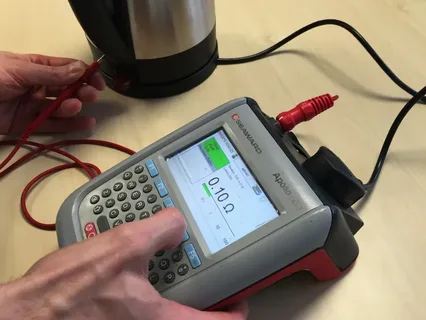
Using calibrated PAT testing equipment, we check for earth continuity, insulation resistance, and polarity to ensure each appliance meets safety standards.
Labelling and Asset Identification
Each tested appliance receives a clear PASS or FAIL label, along with the test date, engineer ID, and a unique barcode to track and log each item accurately.
Digital Report and Certificate
Within 24 hours, we issue a detailed digital PAT Test Certificate and report listing all tested items, complete with readings for compliance and record-keeping.
Free Retest Reminder
We log your next test due date in our system and send you automated reminders so you stay compliant without worrying about missed deadlines.
Book Professional PAT Testing in London
If you manage property in London and want clear, reliable and professionally documented PAT testing, we are ready to help.
Portable Appliance Testing for Residential Properties
Residential properties often contain a wide range of portable appliances.
- Rental flats and houses
- HMOs and shared accommodation
- Student accommodation and serviced apartments
- Testing between tenancies
- Supplied appliances versus tenant-owned equipment
PAT Testing for Commercial and Industrial Premises
Commercial environments present different risk profiles.
- Office environments and shared workspaces
- Shops, cafés and restaurants
- Warehouses and light industrial units
- Construction sites and temporary power equipment
- High-risk environments and heavy usage equipment

What Is Included in Our Portable Appliance Testing Service
Our approach combines inspection, testing and documentation.
Visual inspection of plugs, cables and appliance casing:We examine external condition, cable integrity, plug wiring and signs of overheating.
Earth continuity and insulation resistance testing:Where applicable, electrical tests confirm protective conductors and insulation performance.
Polarity checks and leakage testing where required:Additional tests are carried out where appropriate based on appliance class.
Testing of Class I, Class II and Class III appliances:Each appliance type is tested using the correct procedure.
Extension leads, adaptors and IEC cables:These are often overlooked but present significant risk if damaged.
110V, 240V and 415V equipment capability:We are equipped to test across standard UK voltage ranges.
Compliance-Grade Documentation and Asset Tracking
Documentation is as important as the testing itself.
Unique asset identification and labelling:Each appliance receives a clear label with pass or fail status and retest date.
Digital appliance register for record keeping:You receive a structured register listing each item, location and result.
Pass and fail categorisation with retest dates:Clear categorisation supports maintenance planning.
Engineer certification details and calibration assurance:Reports include tester identification and calibration references.
Secure storage and renewal reminders:We can support ongoing compliance through renewal scheduling.
Our Risk-Based Approach to Portable Appliance Testing
Testing frequency is determined by risk.
Assessing environment and usage patterns:A low-use office differs significantly from a busy HMO kitchen or construction site.
Determining appropriate inspection intervals:Intervals are based on environment, appliance type and risk exposure.
Adjusting frequency for high-risk equipment:High-use or high-risk items may require more frequent inspection.
Using previous failure history to guide retesting:Historical data informs future scheduling decisions.
Aligning testing schedules with property management cycles:We coordinate testing around tenancy renewals and property inspections.
Minimal Disruption and Flexible Appointment Scheduling
We understand that access and timing matter.
Evening and weekend testing availability:Appointments can be arranged outside normal business hours.
Coordinating directly with tenants where required:With your permission, we can liaise directly to arrange access.
Phased testing for larger sites:Larger premises can be tested in stages to minimise disruption.
Professional conduct in occupied properties:Our engineers work respectfully and efficiently in lived-in environments.
DBS-checked engineers for sensitive environments:Suitable for schools, healthcare and similar settings.
Environment / Property Type | Typical Risk Level | Suggested Inspection & Testing Interval* | Practical Notes |
Low-risk office environments | Low | Every 2–4 years | IT equipment and low-movement appliances in stable office settings usually present lower risk if visually checked regularly. |
Rental properties (single let) | Medium | Every 1–2 years | Landlord-supplied appliances such as kettles, microwaves and washing machines should be included in a structured cycle. |
HMOs and shared accommodation | Medium to High | Annually | Higher usage and shared kitchens increase wear and tear. Annual testing is common practice. |
Retail and hospitality settings | Medium to High | Every 6–12 months | Frequent use of appliances such as coffee machines, display fridges and portable heaters justifies shorter intervals. |
Schools and healthcare settings | Medium | Annually | Duty of care is heightened due to vulnerable occupants. Documentation is particularly important. |
Construction sites (110V tools) | High | Every 3 months | Heavy usage, movement and site conditions increase damage risk. Regular testing is industry standard. |
Industrial and workshop equipment | High | Every 6–12 months | Harsh environments and mechanical strain can accelerate deterioration. |
PAT Testing vs EICR – Understanding the Difference
These services address different aspects of electrical safety.
Portable appliances versus fixed wiring:Portable Appliance Testing focuses on plug-in equipment. EICR assesses fixed installation wiring.
Scope of inspection and level of testing:PAT is appliance-specific. EICR involves inspection of circuits, consumer units and distribution systems.
When both services may be required:Landlords and commercial property owners often require both to demonstrate comprehensive electrical compliance.
Coordinating electrical compliance services efficiently:We can advise on aligning inspection schedules to reduce disruption.
Preparing for Your Portable Appliance Testing Visit
Preparation helps the process run smoothly.
Ensuring appliances are accessible:Items should be reachable and unplugged where possible.
Informing tenants or staff in advance:Clear communication avoids delays.
Identifying restricted or sensitive areas:Advance notice helps plan site access.
Grouping extension leads and portable equipment:Organised equipment reduces testing time.
Confirming site contact details:A responsible contact should be available during testing.
Portfolio and Multi-Property Portable Appliance Test Compliance Management
For agents and property managers, coordination is key.
Centralised documentation for property managers:All records can be organised by property or portfolio.
Renewal tracking and scheduled reminders:We help prevent missed inspection dates.
Consolidated invoicing across multiple sites:Simplified administration for busy portfolios.
Dedicated contact for ongoing compliance support:Consistent communication improves efficiency.
Efficient testing between tenancy changes:Fast turnaround supports smooth handovers.
Why Choose Safety Spectrum London For Portable Appliance Test
Choosing the right contractor is about trust.
- NICEIC accredited electrical professionals
- City & Guilds qualified PAT testers
- Fully insured with public liability cover
- Calibrated and traceable testing equipment
- Established experience working with London property professionals
- Commitment to safety, clarity and reliable documentation
Frequently Asked Questions (FAQ)
What is PAT Testing and why is it needed?
PAT Testing ensures that your electrical appliances are safe to use. It significantly reduces the risk of electric shocks, electrical fires, and other hazards.
How long does PAT Testing take?
Most appointments take between 1 and 3 hours, depending on the number of appliances and the size of the property.
Is PAT Testing a legal requirement?
While not strictly mandatory, PAT Testing helps you comply with the Electricity at Work Regulations 1989 and is often required by insurers and regulators.
How often should appliances be tested?
Offices: every 24 monthsHigh-risk environments: every 6–12 monthsRental properties (landlords): every 12 months
What happens if an appliance fails the test?
It will be clearly marked with a “Fail” label, included in your report, and our engineer will advise whether the item should be repaired or replaced.
Who can carry out PAT Testing?
Only a competent person—trained under City andGuilds 2377 and using calibrated equipment—is qualified to carry out PAT Testing.
Do you offer same-day PAT Testing in London?
Yes. We offer same-day and next-day bookings across all London boroughs, including evenings and weekends.
Are new appliances required to be tested?
New appliances should be given a visual inspection before first use and included in the next scheduled testing cycle.
Do you offer discounts for multiple properties or agencies?
Yes. We offer reduced rates for landlords, estate agents, and facilities managers handling multiple properties or sites.
Accreditations and Compliance Guarantee


