Safety Spectrum London provides the complete range of electrical repair and installation services across London — for residential properties, commercial premises, HMOs, rental properties, and landlord portfolios. From a single faulty socket in a Hackney flat to a full commercial rewire in the City, every job is carried out by NICEIC-approved electricians, certificated on completion, and Part P compliant where notifiable.
This page covers every electrical repair and installation service we offer — the same services shown at the top of this page: Repairs (lighting, switches, sockets, fuse boxes, consumer units, extractor fans and hoods, PAT testing, heating controls, faulty wiring and circuits, underfloor heating) and Installation (new lighting systems, LED conversions, fuse boxes, consumer units, extractor fans and hoods, immersion heaters, full and partial rewiring, heating controls, and reports and safety inspections).
We cover all London postcodes. For EICR certificates and EICR remedial works, see our dedicated service pages. For questions about any service not listed here, call +44 20 4617 8121 — our engineers handle the full range of domestic and commercial electrical work.
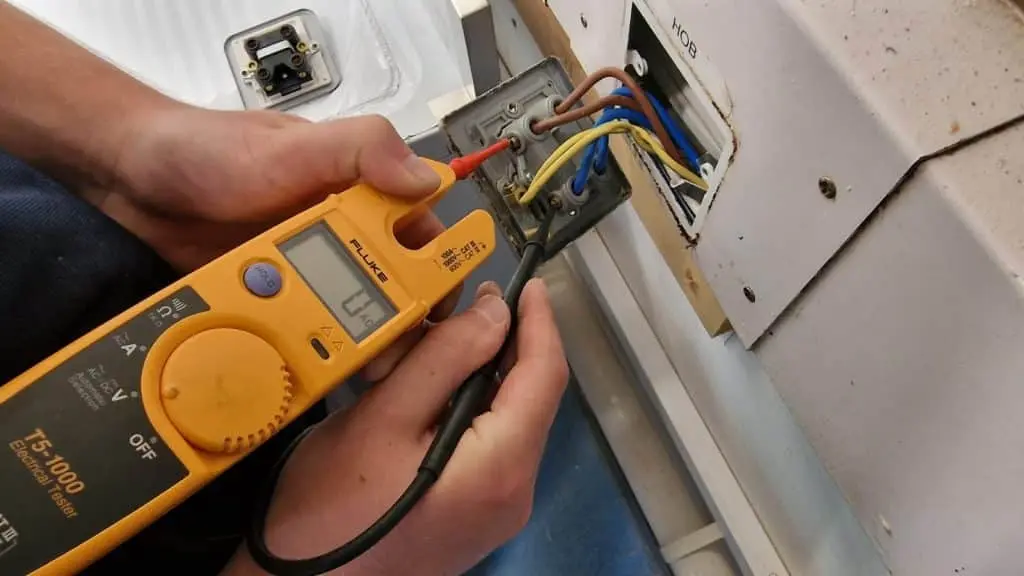
At Safety Spectrum London, we deliver all types of EICR testing and certification your one trusted team for complete electrical safety compliance.
We offer professional EICR testing for offices and commercial sites, ensuring your business stays fully compliant with minimal disruption.
We deliver quick, accurate electrical fault-finding to identify issues early and prevent costly repairs or system failures.
We provide fast, certified electrical inspections for homes and rentals, ensuring complete safety and compliance at competitive rates.
We provide modern, compliant fuse box upgrades that enhance safety, reduce tripping, and meet all 18th-Edition regulations.
We offer reliable emergency lighting inspections and certification to ensure your building meets all legal and safety standards.
We provide fast, efficient PAT testing with instant digital reports to keep your appliances, staff, and tenants fully protected.
Every service listed below is available for residential and commercial properties across London. Repairs are typically same-day. Installations are scheduled within two to five working days. A certificate is issued for every notifiable installation and every EICR remedial.
ELECTRICAL REPAIRS | ELECTRICAL INSTALLATION |
Lighting — flickering, dead fixtures, LED driver failure | New Lighting Systems — downlighters, LED schemes, outdoor circuits |
Switches & Sockets — replacement, repair, overheating faults | LED Conversions — full property LED upgrade, dimmer compatibility |
Fuse Boxes — tripping MCBs, RCD faults, circuit breaker diagnosis | Fuse Box / Consumer Unit — Wylex or Crabtree, EIC issued, Part P notified |
Consumer Units — individual breaker replacement, fault tracing | Extractor Fans & Hoods — Xpelair supply and fit, humidity-sensing models |
Extractor Fans & Hoods — humidistat, timer, motor failure, cooker hood | Immersion Heaters — element replacement, timer, new 20A circuit |
PAT Testing — landlord and commercial; written register issued | Full & Partial Rewiring — EIC included, Part P notified, period homes |
Faulty Wiring / Circuits — dead circuits, power loss, post-EICR remedials | Reports & Inspections — EICR, EIC, Minor Works, PAT — all certified |
Lighting faults in London properties range from a single dead downlighter — usually a failed LED driver — to flickering across an entire circuit. The correct diagnosis before any part is replaced saves time and money. We identify the cause first, then fix only what has actually failed.
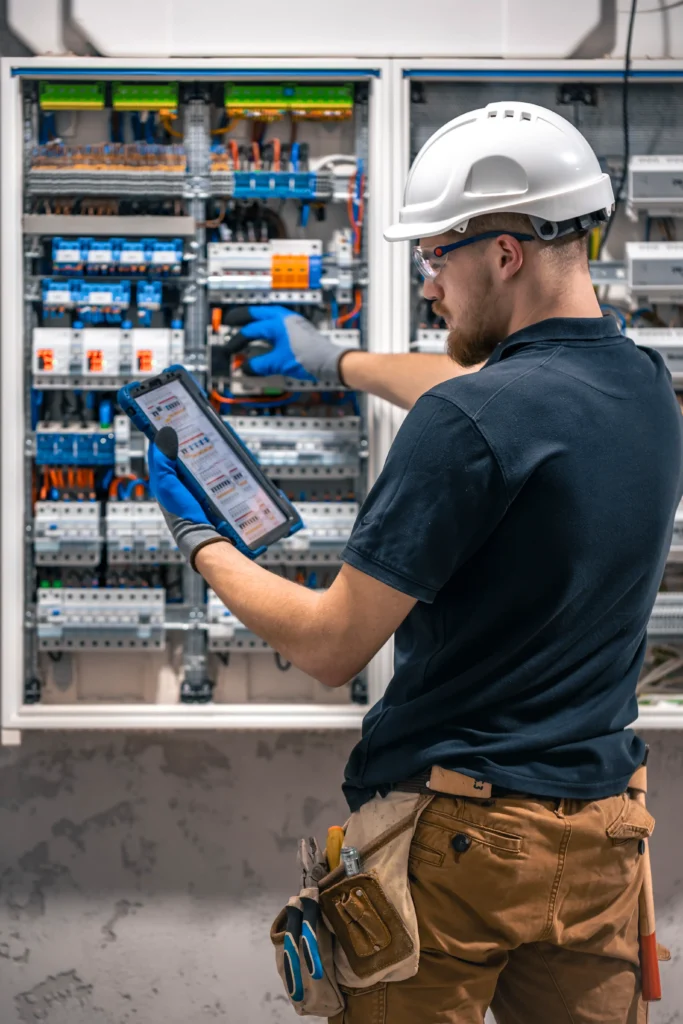
We supply and install MK and Crabtree switches and sockets. Standard sockets do not have serviceable internal parts — when a socket shows signs of failure or overheating, replacement is the correct resolution.
A tripped circuit breaker or RCD that will not reset means the protective device is working correctly — there is a fault on the protected circuit. We find the fault and fix it, not just reset and hope. We carry Wylex and Crabtree MCBs and RCDs on the van for same-visit replacement.
Wiring faults are the most consequential electrical repair category. We locate faults systematically using calibrated insulation resistance testers, earth loop impedance meters, and RCD testers — not by trial and error.
Our PAT testing service covers landlord, HMO, and commercial requirements across London. A full written register is issued after every session.
New lighting systems: All new lighting circuits are RCD-protected per BS 7671:2018+A2:2022 Amendment 3. All notifiable works are Part P certified and Building Control notified through our NICEIC membership. An Electrical Installation Certificate (EIC) is issued on completion of every new circuit installation.
LED conversions: LED conversion requires circuit assessment, dimmer compatibility review, and correct driver specification — not just swapping bulbs. Getting this wrong causes flickering, buzzing, and nuisance RCD tripping. We assess before specifying, and specify correctly before fitting.
Fuse box and consumer unit installation
All consumer unit installations are Part P notifiable, Building Control submitted via our NICEIC membership, and certificated with an Electrical Installation Certificate (EIC). We supply and install Wylex and Crabtree units. See our dedicated fuse box installation page for full detail.
Full and partial rewiring
All rewiring work is certificated with an EIC and notified to Building Control via our NICEIC membership. We have specific experience with London period properties — Victorian and Edwardian terraces, inter-war mansion flats, and post-war residential blocks — where rewiring requires protecting original features and coordinating with other trades.
Reports and safety inspections — certificates issued
Every installation and repair we carry out includes the relevant compliance certificate. For standalone inspections and reports, see our dedicated service pages.
All prices below are guide figures for London work. Final cost depends on property access, extent of work, and parts specification. We provide a written quote before any work begins — no hidden charges. Call +44 20 4617 8121 for an accurate quote on your specific job. For EICR costs specifically, see our EICR cost guide.
Service | Typical Cost | What’s Included |
Socket or switch replacement | £65–£120 | Labour, new fitting (MK/Crabtree), connection check |
Lighting repair / LED driver replacement | £75–£180 | Diagnosis + new driver or fitting; same-day resolution |
Circuit fault diagnosis | £95–£150 | First hour; most faults found and fixed on same visit |
Consumer unit (fuse box) replacement | £400–£700 | Wylex/Crabtree unit, EIC, Part P notification, testing |
Extractor fan replacement (Xpelair) | £120–£220 | Supply and fit; humidity-sensing models available |
Immersion heater replacement | £150–£250 | Element, isolation switch, new circuit if required |
UFH thermostat / sensor replacement | £80–£160 | No floor lifting required in most cases |
Heating controls (Honeywell thermostat) | £120–£280 | Supply, fit, and configure; smart thermostat at upper end |
Full rewire — 1 bed flat | From £2,800 | EIC and Part P notification included |
Full rewire — 3 bed house | From £5,500 | New consumer unit, EIC, Part P included |
PAT testing — per session | From £75 | Full written register; landlord and commercial |
How we charge — transparent from the first call For repair visits, we charge from time of arrival — no separate call-out charge. Simple repairs are carried out on the first visit. Larger works requiring parts or a return visit are quoted in writing before any additional work is agreed. Installation projects are quoted before starting. The price on the quote is the price on the invoice unless unforeseen conditions are discovered and discussed with you at the time. |
Different London property types present different electrical fault patterns. Understanding what is common in your property type sets realistic expectations before an engineer visits — and avoids the situation where a different provider gives you a vague diagnosis because they are unfamiliar with the property type.
Property Type | Most Common Faults in London | Our Approach |
Victorian & Edwardian terrace | Rubber-insulated wiring at end of life, absent RCD protection, deteriorated earthing, ceiling rose failures, consumer units pre-dating 2008 | Systematic circuit testing; honest assessment of whether targeted repair or full rewire is the better long-term investment. EIC issued for all new installation works |
Inter-war mansion flat | Fragmented wiring from multiple partial rewires, consumer unit in communal riser, distribution board boundary ambiguity between flat and building | Freeholder coordination arranged; distribution boundary confirmed before inspection begins; full circuit testing on the flat installation |
Post-war flat 1950s–1970s | Wiring approaching or past end of reliable service life, no RCD protection in original consumer units, insufficient socket provision | Age-based wiring condition report; consumer unit upgrade recommendation with circuit-by-circuit insulation resistance and continuity testing |
Modern new-build flat | Nuisance RCD tripping caused by smart home devices, EV chargers, and LED drivers; MCBs incorrectly rated for installed circuits | Isolation testing to identify tripping source precisely; RCBO replacement with correctly rated breakers; LED circuit and dimmer compatibility review |
HMO — shared house | Overloaded shared ring mains, tenant-damaged sockets and pull-cords, overloaded multi-socket extensions, external security lighting faults | Methodical room-by-room fault finding with minimal tenant disruption. Full written report provided to landlord for HMO licence compliance. EICR guidance included |
Commercial premises | Distribution board faults, safety and emergency lighting failures, PAT compliance gaps, circuit overloads from equipment upgrades | Commercial-grade fault diagnosis using calibrated test equipment. PAT testing with full written register. EIC on all new commercial circuit installations |
NICEIC-approved · Part P certified · City & Guilds qualified · Residential & commercial · Rated 4.9 on Google
Our residential electrical service covers all domestic property types in London — private homes, rented flats, Victorian terraces, mansion flats, modern new-builds, and HMOs. For residential landlords, we provide a complete compliance package: EICR inspection, EICR remedial works, PAT testing, and all repair and installation work from a single provider. We provide written reports of every repair visit — essential for HMO licence compliance and for demonstrating due diligence in the event of tenant damage disputes.
Our commercial electrical service covers all commercial property types in London — offices, retail units, restaurants, hospitality venues, medical and dental premises, mixed-use buildings, and commercial blocks.
Every engineer working under the Safety Spectrum London name holds the accreditations shown at the top of this page. These are not historic qualifications — they are current, maintained registrations that can be verified on the relevant public registers.
ACCREDITATIONS AND COMPLIANCE GUARANTEE
Every engineer is qualified, every job is certified, every accreditation is verified:
IFSM Technician | Gas Safe Register | NEBOSH Qualified | City & Guilds Certified | TrustMark Gov. Endorsed | NICEIC Approved Contractor |
Approved materials brands — supplied from authorised distributors only:
WYLEX Approved Brand | CRABTREE Approved Brand | HONEYWELL Approved Brand | XPELAIR Approved Brand | MK Approved Brand |
Call us immediately if you notice any of these — do not ignore electrical warning signs Frequent fuse trips or RCD resets — your system may be overloaded or there is a short circuit on one of your circuits Flickering, dimming or buzzing lights — loose wiring, an overloaded circuit, or a failing fixture; not always just a bulb issue Burning smell or discoloured socket — overheated wiring or components; isolate the circuit and call us immediately Loose or sparking power outlets — sockets that move, crackle, or feel hot are a clear electrical hazard Buzzing from consumer unit or sockets — a constant electrical buzz is not normal and may indicate a serious fault Extractor fan running continuously — in most London bathroom fan calls this is a failed humidistat, not a broken fan Appliances behaving unpredictably — tripping when plugged in, or flickering screens; the issue may be the wiring, not the appliance Underfloor heating error codes — do not lift flooring before calling us; most UFH faults are in the thermostat or sensor, not the cable |
Certificate issued after every repair and installation — legally yours to keep Electrical Installation Certificate (EIC) — issued after all new circuit and consumer unit installations; required for mortgage, insurance, and property sale Minor Electrical Works Certificate — issued after additions to existing circuits such as new sockets, lighting points, and minor works EICR Remedial Works Certificate — re-test certificate issued after all C1 and C2 fault remediation; confirms the installation is now satisfactory PAT Testing Register — full written register of all appliances tested, results, and pass/fail status; issued after every PAT session Part P Building Control Notification — we submit all notifiable works to building control through our NICEIC membership; no separate LA application required |
We provide Complete EICR inspections across:
London buildings often include older wiring routes, converted flats, mixed-use blocks, and shared intakes. Our engineers are experienced in carrying out a thorough electrical safety check in these environments, ensuring minimal disruption for tenants and neighbours while maintaining full compliance.
Fixed wire testing is the formal inspection and testing of all permanently installed electrical wiring and circuits within a building, carried out in accordance with BS 7671:2018 by a qualified electrician. It covers all fixed circuits, distribution boards, earthing, bonding, and associated electrical equipment. The test produces an Electrical Installation Condition Report (EICR), which records the condition of the installation and any observations requiring remedial action.
Fixed wire testing describes the process of inspecting and testing a building's fixed electrical installation. The EICR (Electrical Installation Condition Report) is the formal document produced as the outcome of that process. The two terms refer to the same service. Other synonyms include periodic inspection and testing, hardwire testing, and periodic electrical inspection.
The required frequency depends on the type of property. Residential rental properties in England must be tested at least every five years. Offices, retail premises, schools, hotels, and restaurants have a maximum recommended interval of five years. Industrial premises have a maximum of three years. Caravan parks, marinas, and swimming pools require annual testing. An installation that has been damaged, or that received an unsatisfactory result at its previous test, should be re-tested sooner.
For residential landlords in England, yes it has been a legal requirement since June 2020 under the Electrical Safety Standards in the Private Rented Sector (England) Regulations 2020. For commercial property owners and business occupiers, the Electricity at Work Regulations 1989 create a legal duty to maintain safe electrical systems, for which a current fixed wire test certificate is the accepted evidence of compliance. Most commercial property insurers now require a current EICR as a condition of cover.
An unsatisfactory fixed wire test one containing C1 (Danger Present) or C2 (Potentially Dangerous) observations requires remedial works to be completed and a re-inspection conducted. For residential landlords in England, remedial works must be completed within 28 days of receiving the unsatisfactory EICR. Our EICR remedial works service covers all rectification work required following an unsatisfactory inspection.
For a domestic property with up to 10 circuits, a fixed wire test typically takes between two and four hours. A small commercial premises with up to 20 circuits will typically take four to six hours. Larger commercial installations and multi-board buildings may require a full day or a planned multi-day programme.
Not in its entirety. Each circuit must be isolated briefly during its own tests — typically for five to fifteen minutes per circuit. Only one circuit is offline at any time, and circuits are restored immediately after testing. The main supply is not disconnected. For circuits serving critical systems, isolation is planned and coordinated with the client in advance.
A qualified fixed wire testing engineer should hold the City & Guilds 2391-52 Award in the Periodic Inspection, Testing and Certification of Electrical Installations, or an equivalent qualification, and should work for a contractor registered with the NICEIC, NAPIT, or an equivalent government-approved competent person scheme. Always verify the contractor's registration before commissioning a test.
C1 (Danger Present) means immediate remedial action is required. C2 (Potentially Dangerous) means urgent remedial action is required. Both C1 and C2 observations result in an unsatisfactory EICR. C3 (Improvement Recommended) records a departure from current standards that does not present an immediate safety risk; a certificate with only C3 observations is a satisfactory EICR. FI (Further Investigation Required) records a condition that cannot be fully assessed within the standard inspection.
Yes. A satisfactory EICR issued by a NICEIC-approved contractor is the standard documentary evidence accepted by commercial property and landlord insurers as proof that an electrical installation has been maintained in accordance with the Electricity at Work Regulations 1989. Verify the precise wording of your policy's electrical safety condition with your insurer.


© 2026 Safety Spectrum London – All Rights Reserved. Company Reg No.16678881
Live Chat