
EICR Certificate South London | Same-Day Electrical Safety Inspections
Looking for an EICR in South London? An Electrical Safety Certificate checks the safety of the fixed wiring, consumer unit, sockets and earthing in your property, and is a legal requirement for every rented home in England. We inspect properties across South London, from Islington to Enfield, with transparent pricing from £79 and same-day digital reports.
What Is an EICR and Do You Need One in South London?
Electrical Installation Condition Report: The Legal Definition: An Electrical Installation Condition Report (EICR) is a formal safety assessment of a property’s fixed electrical installation, the wiring, consumer unit, sockets, and earthing carried out by a qualified electrician against the UK wiring standard, BS 7671, published by the Institution of Engineering and Technology. The inspector tests circuits, checks for damage or wear, and issues a satisfactory or unsatisfactory result with any faults coded by severity.
Who Legally Requires an EICR: Private landlords in England must have a valid EICR for every rented property, renewed at least every 5 years, under The Electrical Safety Standards in the Private Rented Sector (England) Regulations 2020. Homeowners and commercial property owners aren’t legally required to hold one, but insurers, mortgage lenders, and conveyancing solicitors increasingly ask for a recent report before completing a sale or renewing cover.
Our Commercial EICR And Residential EICR Costs in South London
Commercial properties typically cost more due to larger wiring networks, but our pricing is fair and competitive.
We Offer Complete EICR Service Options in London
At Safety Spectrum London, we deliver all types of EICR testing and certification your one trusted team for complete electrical safety compliance.
Commercial EICR
We offer professional EICR testing for offices and commercial sites, ensuring your business stays fully compliant with minimal disruption.
Electrical Diagnostics
We deliver quick, accurate electrical fault-finding to identify issues early and prevent costly repairs or system failures.
Residential EICR
We provide fast, certified electrical inspections for homes and rentals, ensuring complete safety and compliance at competitive rates.
Fuse Box Installation
We provide modern, compliant fuse box upgrades that enhance safety, reduce tripping, and meet all 18th-Edition regulations.
Emergency Lighting Certificate
We offer reliable emergency lighting inspections and certification to ensure your building meets all legal and safety standards.
PAT Testing
We provide fast, efficient PAT testing with instant digital reports to keep your appliances, staff, and tenants fully protected.
Book Your South London EICR Today
Call 24/7 or book online. Our accredited engineers will conduct your inspection, provide a full report within 24 hours, and make sure your property is safe and compliant.
EICR Services for Every South London Property Owner
Landlords and Letting Agents: We issue your Landlord Electrical Safety Certificate with the 5-year renewal date, 28-day disclosure paperwork, and a remedial quote on the same visit if anything needs fixing, so you’re never chasing two separate appointments to stay compliant.
Homeowners and Buyers: Buying an older South London property, or haven’t had the wiring checked in over a decade? A Residential EICR gives you a clear, documented picture of any hidden risk before it becomes an expensive surprise, and it’s often requested by insurers and mortgage lenders on older housing stock.
HMO Landlords: HMOs carry stricter electrical safety expectations under most local licensing schemes. We test every circuit across shared and private areas and flag anything that could affect your HMO licence renewal.
Commercial and Office Properties: Our Commercial EICR service typically runs on a shorter cycle (often every 5 years, sometimes less for higher-risk premises) and covers higher circuit counts. We work around your opening hours to minimise disruption, and can pair this with an Emergency Lighting Certificate if your premises requires one.
EICR Coverage Across South London
Each subsection below is a strong candidate for its own indexable page (e.g. /eicr-South-london/eicr-islington-n1/), this is the biggest content gap identified against all 13 competitors.
Islington & Highbury: EICR inspections across N1 and N5, including Victorian terraces and converted period flats around Upper Street and Highbury Fields.
Highgate & Crouch End: Covering N6, N8 and N10, common finds here include older fuse boards in unmodernised Victorian and Edwardian houses.
Muswell Hill & Alexandra Palace: Serving N10 and N22, including the area’s characteristic Edwardian terraces and converted maisonettes.
Finchley (Central, East, South, Woodside Park): Covering N2, N3, N12 and N20, a mix of 1930s semis and newer developments near Woodside Park.
Camden Town & Hampstead: Serving NW1, NW3 and NW5, including period conversions and HMOs common in the area’s private rental market.
Finsbury Park & Wood Green: Covering N4 and N22, a high density of converted flats and HMOs, where circuit counts tend to run higher.
Southgate, Palmers Green & Winchmore Hill: Serving N13, N14 and N21, largely 1930s-1950s semi-detached housing with original wiring still common in unmodernised homes.
Edmonton, Enfield & Barnet: Covering N9, N18, EN1-EN5, a broad mix of housing stock from Victorian terraces to modern new-builds near Enfield Town.
Service Areas Across London
We provide Complete EICR inspections across:
Your Legal Obligations as a South London Landlord
The 5-Year EICR Renewal Rule: Landlords in England must renew their EICR at least every 5 years, or sooner if the previous report specifies an earlier retest date. The clock starts from the date of the last satisfactory inspection, not the tenancy start date.
28-Day Tenant Disclosure Requirement: Once your EICR is complete, you must provide a copy to existing tenants within 28 days, and to new tenants before they move in. Local authorities can also request a copy within 7 days of asking.
Penalties: Fines Up to £30,000: Local councils can issue civil penalties of up to £30,000 for landlords who fail to obtain a valid EICR, fail to act on required remedial work, or fail to share the report with tenants within the legal timeframe. Full detail is set out in The Electrical Safety Standards in the Private Rented Sector (England) Regulations 2020.
HMO-Specific Requirements: HMOs are subject to the same 5-year EICR rule, but many local licensing schemes also require the report to be submitted as part of licence applications and renewals, check your specific South London borough’s HMO licensing conditions.
How an EICR Inspection Works: Step by Step
Book Your Inspection: Confirm your price using the calculator or by phone/WhatsApp, and choose a convenient appointment time.
Visual Inspection of Your Electrical Installation: The engineer visually checks the consumer unit, visible wiring, sockets, switches and earthing for damage, wear, or non-compliant work.
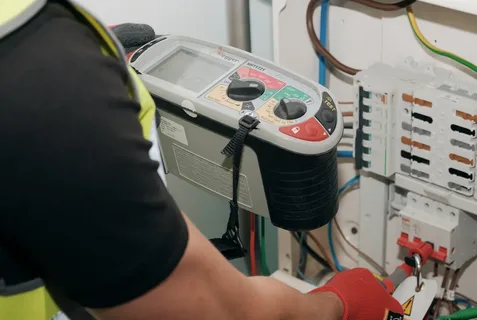
Dead Testing and Live Testing: Circuits are tested with the power off (dead testing) and then on (live testing) to check insulation resistance, earth continuity, and RCD trip times, the same process used in our standalone Fixed Wire Testing service.
Coding and Risk Classification: Any issues found are coded by severity, C1, C2, C3 or FI, so you know exactly what, if anything, needs fixing and how urgently.
Digital Report Delivered: You receive your full EICR as a digital PDF, typically within 24-48 hours of the inspection.
Remedial Work Quote (If Required): If any C1 or C2 issues are found, our EICR Remedial Work team can provide a fixed-price quote on the same visit, backed by our wider Electrical Repairs & Installation service if larger works are needed.
Understanding Your EICR Result: C1, C2, C3 and FI Codes
C1, Danger Present, Immediate Action Required: A C1 code means there is a danger present that poses an immediate risk of injury, such as exposed live parts. This must be fixed immediately, and in most cases the electrician will make the installation safe on the spot before leaving.
C2, Potentially Dangerous: A C2 code means a fault is present that could become dangerous, such as a missing earth connection. It doesn’t require immediate action on-site but should be remedied urgently, and it makes the overall report “unsatisfactory” until fixed.
C3, Improvement Recommended: A C3 code flags an area that doesn’t meet the current wiring regulations but isn’t unsafe, for example, older cabling that was compliant when installed. It’s a recommendation, not a requirement, and doesn’t make the report unsatisfactory.
FI, Further Investigation Required: An FI code means the inspector couldn’t fully assess an issue during the visit, for example, a circuit that couldn’t be safely isolated, and recommends a follow-up Electrical Diagnostic visit.
What Happens If Your EICR Is Unsatisfactory: An “unsatisfactory” result (triggered by any C1 or C2 code) means the property doesn’t meet the required safety standard. Landlords must complete the necessary remedial work within 28 days, or sooner if the report specifies, and provide written confirmation to the tenant and local authority.
EICR vs EIC vs Minor Works Certificate: Which Do You Need?
EICR vs Electrical Installation Certificate (EIC): An EICR assesses the condition of an existing electrical installation and is what landlords need for compliance. An Electrical Installation Certificate (EIC) is issued for new electrical installation work, for example, a full rewire or a new consumer unit, confirming the new work meets BS 7671. You need an EIC when new work is completed, and an EICR to periodically check an installation’s ongoing condition.
EICR vs Minor Electrical Installation Works Certificate: A Minor Works Certificate covers small, self-contained jobs that don’t involve a new circuit, such as adding a socket or replacing a light fitting. It confirms that specific piece of work is safe, but it isn’t a substitute for a full EICR, which assesses the entire installation.
Common Electrical Issues Found in South London Properties
Victorian and Edwardian Terraces (Islington, Highgate, Crouch End): Original wiring, undersized earthing, and outdated fuse boards are common in unmodernised period properties, often carrying C2 codes for missing RCD protection.
1930s-1970s Semis (Southgate, Winchmore Hill, Edmonton): Rewires from this era often used now-outdated cable types and consumer units that don’t meet current RCD and surge protection standards.
Converted Flats and HMOs: Multiple rewiring stages by different contractors over the years can leave inconsistent circuit labelling and shared consumer units that complicate testing and increase circuit counts.
Modern New-Build Apartments: Generally the fewest issues, though developer-fit sockets and shared building supplies can still throw up minor C3 recommendations.
Why an Out-of-Date EICR Puts You at Risk
Insurance Claims and a Lapsed EICR: If a fire or electrical fault causes damage and your EICR has lapsed, your buildings or landlord insurance provider may have grounds to dispute or reduce a claim payout, since maintaining a valid safety certificate is a standard policy condition.
Fire and Electric Shock Risk Statistics: Faulty wiring and electrical faults remain a leading cause of accidental house fires in the UK, which is part of why a periodic, professional inspection, rather than relying on visible condition alone, is required by law for rented homes.
Why an Out-of-Date EICR Puts You at Risk
Insurance Claims and a Lapsed EICR: If a fire or electrical fault causes damage and your EICR has lapsed, your buildings or landlord insurance provider may have grounds to dispute or reduce a claim payout, since maintaining a valid safety certificate is a standard policy condition.
Fire and Electric Shock Risk Statistics: Faulty wiring and electrical faults remain a leading cause of accidental house fires in the UK, which is part of why a periodic, professional inspection, rather than relying on visible condition alone, is required by law for rented homes.
Related Compliance Services
PAT Testing: Our PAT Testing service covers portable appliances for landlords and businesses with electrical equipment on-site.
Emergency Lighting Certificate: An Emergency Lighting Certificate is required for most commercial and HMO premises alongside your EICR.
Electrical Repairs & Installation:For anything beyond a certificate, new circuits, consumer unit upgrades, or general repairs, see our Electrical Repairs & Installation service.
Fixed Wire Testing: Larger commercial sites often need standalone Fixed Wire Testing between full EICR cycles.
Frequently Asked Questions (FAQ)
How Much Does an EICR Cost in South London?
EICR prices in South London typically start from £79 for a studio or one-bedroom property, rising to around £124+ for a 5-6 bedroom home or HMO, depending on the number of circuits to be tested.
How Long Does an EICR Take?
Most residential EICR inspections take between 1.5 and 3 hours on-site, depending on property size and circuit count, with the full digital report delivered within 24-48 hours.
Do Homeowners Need an EICR, or Only Landlords?
EICRs are a legal requirement for private landlords in England but not for homeowners. However, homeowners buying an older property, or one that hasn't been inspected in over 10 years, are often advised to get one for peace of mind and to satisfy insurer or lender requirements.
Can I Rent My Property Without a Valid EICR?
No. Since June 2020, private landlords in England are legally required to hold a valid EICR for every rented property, renewed at least every 5 years, before the tenancy begins.
What Happens If I Fail My EICR?
An unsatisfactory result means any C1 or C2 issues must be fixed, usually within 28 days. Once remedial work is complete, the electrician confirms the fix in writing, and you keep this alongside your original EICR as proof of compliance.
How Do I Book an EICR in South London?
You can book directly through our online calculator, by WhatsApp, or by phone, most South London appointments can be arranged within 48 hours, with same-day slots often available.
Explore Our complete Services in Central London
Accreditations and Compliance Guarantee


