
Fire safety in HMOs is very important. The risk is higher and so are the legal expectations when there are multiple people living in the same space.
A lot of landlords only do things when it is time to renew a licence or have an inspection, which can lead to hasty choices. A proper fire risk assessment lets you see how safe your property is and helps you stay compliant without having to rush at the last minute.
For homes, apartments, and buildings with shared spaces. We check the lighting, alarms, fire doors, escape routes and shared spaces.
For businesses, offices, stores, restaurants, gyms, and more. Our main concerns are the safety of our employees, the safety of our customers.
For blocks that were built for a specific purpose or changed. We look at stairwells, hallways, communal areas, and fire separation.
A structured inspection called an HMO fire risk assessment finds fire hazards, assesses the risks to people living there, and lists what needs to be done to make things safer.
It’s more than just a list of things to do. It looks at how the property is used, how a fire could start or spread, and whether people can get out safely. The Regulatory Reform (Fire Safety) Order 2005 says that the assessment must be “suitable and sufficient.” This means that it should show the real risks in your property, not just a generic template.
HMOs have a different risk profile than regular homes. You have a lot of people living with you, some of whom may not know each other, shared kitchens, more electricity use, and different levels of knowledge about fire safety.
Common risk factors include:
The UK Home Office’s data shows that fires are more likely to happen in homes where more people live together and share space. Because of this, councils and fire authorities keep a closer eye on HMOs.
Up to 3 Floors (Communal Area)
£119
3–5 Floors (Communal Area)
£239
5–10 Floors (Communal Area)
£299
(Whole Building)
On Call
Studio / 1-Bed
£79
1–3 Bedrooms
£139
4-6 Bedrooms
£169
Communal Area only
£120
The responsibility usually falls on the “responsible person.” In most cases, this will be:
This responsibility is not optional. It includes identifying risks, maintaining fire safety systems, keeping escape routes clear, and ensuring that tenants have access to basic fire safety information.
Not doing a fire risk assessment right away can often lead to bigger problems down the road. If fire safety standards aren’t met, councils can issue improvement notices or limit how a property can be used. In bad cases, the person may be charged with a crime or have to pay a fine.
There is also a risk to the tenants and the property itself, in addition to legal consequences. A fire can kill people, cause a lot of damage, and hurt your finances for a long time.
You can take charge by acting quickly. It lets you plan improvements, spread costs where they are needed, and stay in compliance without putting too much stress on yourself.
This service is for people who are in charge of residential properties with more than one tenant. It doesn’t just apply to big portfolios. Fire safety is just as important for one HMO property as it is for many.
Fire safety in HMOs is covered by several regulations, and understanding them is key to staying compliant and avoiding enforcement action.
This law requires the responsible person to assess fire risks and put safety measures in place, mainly in communal areas such as corridors and staircases.
It introduced the HHSRS, which assesses fire hazards and forms the basis of HMO licensing.
Most HMOs need a licence. Councils expect a valid fire risk assessment and proof that issues have been addressed.
These regulations require regular checks of fire doors in communal areas and flat entrances.
They must: Identify fire hazards, Assess risks, Maintain safety measures, Keep records, Review the assessment regularly
They should be reviewed: Annually, After property changes, When occupancy changes, After any incident
Using outdated reports, Ignoring recommendations, Poor maintenance of fire systems, Lack of records, Not assessing the correct areas
A thorough assessment looks at the property as a whole, not just individual components. It considers how fire could start, how it might spread, and how occupants would respond.
Escape routes, travel distances and final exits:We assess whether occupants can exit the property safely. This includes checking that escape routes are clear, travel distances are reasonable, and exits are accessible.
Shared corridors, stairs and other communal areas:Communal areas are often where risks accumulate. Storage, obstructions, and poor maintenance can significantly increase fire risk.
Fire doors, self-closing devices, seals and door condition:Fire doors play a critical role in containing fire and smoke. We check alignment, gaps, seals, hinges, and closing mechanisms.
Emergency lighting, signage and visibility during an evacuation:In low visibility conditions, emergency lighting is essential. We assess whether lighting and signage support safe evacuation.
We assess how well the property is designed to contain fire within a specific area and prevent rapid spread.
Fire safety is not just about the building. It also depends on how the property is managed and how tenants use the space.
We review whether appropriate records are in place, including alarm testing logs and maintenance documentation.
Even well-maintained properties can have hidden risks. These are some of the most common issues identified during assessments.
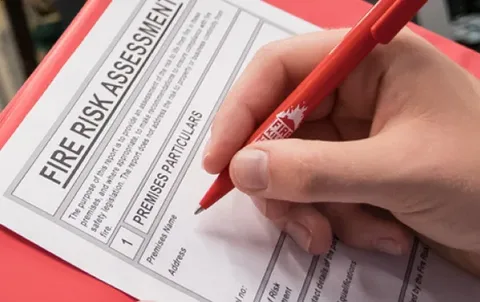
Clarity is one of the most important outcomes of a fire risk assessment. You should know exactly where you stand.
Different property types require different considerations.
A structured approach to fire safety benefits both occupants and property owners.
Reducing the chance of fire and smoke spread:Early identification of risks allows preventative action.
Improving safe escape for occupants and visitors:Clear routes and effective systems support safe evacuation.
Supporting licence applications, renewals and inspections: Compliance documentation helps avoid delays.
Helping landlords avoid avoidable enforcement action: Proper assessment reduces the likelihood of penalties.
Protecting asset value, insurability and operational continuity: Well-managed properties maintain value and stability.
Giving landlords and agents clearer control over compliance risk: Clear information leads to better decision-making.
Fire safety is not limited to one assessment.
Not all assessments provide the same level of clarity or value. The difference often lies in how the information is delivered and how useful it is in practice.
Qualified assessors with experience in rental and multi-occupied properties:Experience in HMOs ensures that the assessment reflects real-world risks.
Practical advice focused on compliance, not confusion:Recommendations are clear and actionable.
Reports written for landlords, agents and decision-makers:The focus is on usability, not technical jargon.
Clear risk prioritisation to support faster action:You can act quickly on the most important issues.
Support with related fire safety issues beyond the assessment:Where needed, guidance can extend beyond the report.
A professional service built around safety, clarity and accountability:The aim is to support long-term compliance, not just one-time reporting.
Keep your business safe, compliant, and fully certified.
Yes, fire safety laws say that a fire risk assessment must be done if there are shared or communal areas.
Most of the time, the focus is on common areas, but the property's overall risk profile is also taken into account.
Usually once a year, or sooner if there are big changes.
It is possible, but it is best to use a qualified assessor to make sure everything is correct and follows the rules.
Yes, each property needs its own assessment.
It depends on how big and complicated the property is.


© 2025 Safety Spectrum London – All Rights Reserved. Company Reg No.16678881
Live Chat